

Why Handmade Embroidery Costs More: A 2026 Guide
Table of Contents
- Why Handmade Embroidery Costs More: The Real Numbers Behind the Needle
- A Worked Pricing Example: What a Single Vestcoat Actually Costs to Make
- Time Required for Hand Embroidery: Hours You Never See on a Price Tag
- Skill, Experience, and Craftsmanship: Why Not Every Stitch Is Equal
- Hand Embroidery vs Machine Embroidery: Two Different Products, Two Different Prices
- Materials, Fabric, and Thread: The Costs That Sit Under the Surface
- How to Price Handmade Embroidery: Fair Wages, Overhead, and Sustainable Margins
- How to Identify Handmade Embroidery Before You Buy
- Durability, Care, and Long-Term Value: Why the Higher Price Often Pays Off
- Frequently Asked Questions
Last Updated: October 12, 2026
Why Handmade Embroidery Costs More: The Real Numbers Behind the Needle
A handmade embroidered garment carries a price machine work never will, because a person made it stitch by stitch over hours or days. At Luqmaan Boutique, we appreciate real craftsmanship. The number looks high until you break it down, then it looks honest.
Handmade embroidery is stitching decorative patterns by hand, with a needle and thread, without a machine guiding the design. The cost reflects labor, skill, and time a production line cannot replicate. Below, we'll show how a single piece gets priced and how to judge quality before you spend.
A Worked Pricing Example: What a Single Vestcoat Actually Costs to Make
Most guides say handmade embroidery is expensive because of labor and stop there, not useful when judging whether a quote is fair.
The example below is illustrative, not a quote. Rates and material costs vary, but the structure is what matters, once you see it, you can sanity-check any price.
| Line Item | Basis | Example Figure |
|---|---|---|
| Embroidery labor | 16 hours at $15/hour | $240 |
| Design and sampling | 3 hours at $15/hour, amortized across a small run | $45 |
| Fabric | Velvet yardage for body and lining | $28 |
| Thread and embellishment | Zari, metallic, and accent thread | $18 |
| Buttons and closures | Brass-style, hand-set | $6 |
| Interfacing and stabilizer | Structural support for dense panels | $4 |
| Packaging | Box, tissue, care card | $5 |
| Overhead allocation | Workshop, tools, lighting, utilities, storage | $22 |
| Payment processing and platform fees | Typical card and marketplace fees | $8 |
| Subtotal | $376 | |
| Profit margin | 15% of subtotal | $56 |
| Retail price | $432 |
- Labor dominates. At 16 hours, even a modest hourly rate produces a labor line larger than every material combined.
- Design time is real time. Pattern development and a sample stitch-out can consume several hours before the first sellable piece exists, on a one-off commission, that cost lands entirely on you.
- Overhead is small per piece but never zero. Rent, tools, lighting, and storage don't disappear because a piece is handmade.
- Fees are invisible until they aren't. Card processing and marketplace commissions take a percentage of the sale.
If a maker quotes $150 for the same vestcoat, one of three things is true: they're underpricing labor, using lighter materials, or the design is genuinely simpler. Ask which.
Time Required for Hand Embroidery: Hours You Never See on a Price Tag
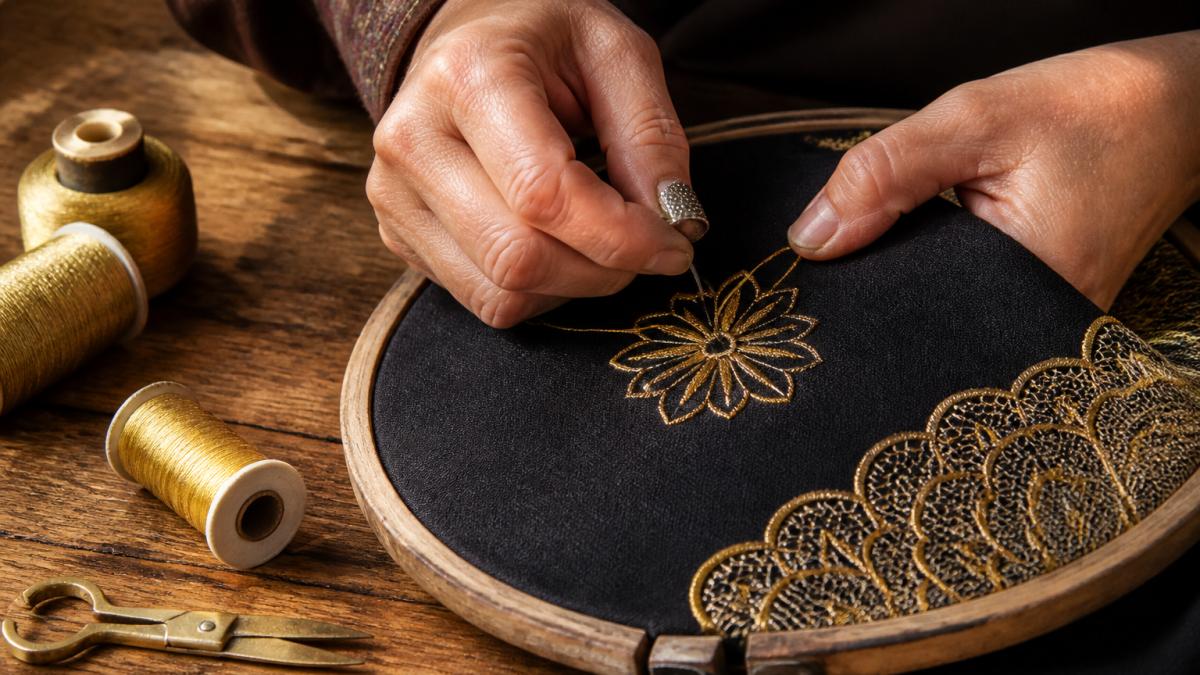
Time is the cost nobody prices correctly. A simple neckline motif might take two hours; a dense chest panel with layered gold threadwork can run past 40. The customer sees a finished garment; the maker sees a week of evenings.
How Stitch Count and Design Complexity Multiply the Hours
Stitch count is the biggest driver of time. A 5,000-stitch floral vine takes far longer than a 500-stitch border, and the relationship isn't linear, dense areas force the embroiderer to slow down and check alignment constantly.
- Simple border or cuff: 2-5 hours
- Neckline motif with moderate density: 6-12 hours
- Full chest panel with layered Zari thread: 15-40+ hours
- Matching shawl border: adds 4-8 hours
Skill, Experience, and Craftsmanship: Why Not Every Stitch Is Equal
Skill determines whether a piece looks refined or rough, and it takes years to develop. An experienced embroiderer knows how to tension thread so it lies flat, hide knots, and keep symmetry across a large panel; a beginner can produce the same stitch count and a visibly inferior result.
That experience is a cost. Makers who have spent a decade perfecting Khamak and Shesha Yakhan techniques charge more because their work holds up under close inspection. Comparing two pieces by photo alone is a mistake, a phone camera flattens the difference between tight, even stitching and loose, uneven work.
Hand Embroidery vs Machine Embroidery: Two Different Products, Two Different Prices
Hand embroidery and machine embroidery are not the same product at different price points, they are different goods that share a name. A machine produces uniform, repeatable patterns at speed; a person produces slight variations, denser texture, and a design adjustable mid-stitch.
| Factor | Hand Embroidery | Machine Embroidery |
|---|---|---|
| Speed | Hours to days per piece | Minutes per piece |
| Consistency | Slight natural variation | Identical every run |
| Texture | Raised, layered, dimensional | Flatter, more uniform |
| Design changes | Possible mid-piece | Requires re-digitizing |
| Cost per piece | High | Low |
| Uniqueness | One-of-a-kind | Reproducible in bulk |
Where Machine Work Wins and Where It Falls Short
Machine embroidery is better for bulk orders, uniforms, logo placement, and simple geometric patterns where consistency matters more than texture.
Where it falls short is in the qualities buyers actually want from a celebration garment: depth, individuality, and the sense that no one else owns the exact same piece. Machine work can imitate a floral motif. It cannot replicate the small irregularities that make handwork feel alive.
Materials, Fabric, and Thread: The Costs That Sit Under the Surface
Materials set the floor for price before a single stitch is placed, and they change how long stitching takes.
Fabric. The ground fabric determines how forgiving the work is. Velvet is dense and plush, so a misplaced needle leaves a permanent mark and the embroiderer must slow down.
Thread. Not all thread behaves the same under tension. Standard polyester is inexpensive, colorfast, and easy to tension. Metallic-wrapped thread, often sold as Zari, costs more, tarnishes if handled poorly, and needs constant tension adjustment.
Embellishment and findings. Brass-style buttons, hand-set closures, beads, sequins, and interfacing all add cost and time.
Men’s Black Parahan Tumban with Gold Hand Khamak Embroidery – Luxury →
| Material | Cost Level | Handling Difficulty | Effect on Price |
|---|---|---|---|
| Velvet | High | High, permanent marks | Raises labor hours |
| Silk | High | High, snags easily | Raises labor hours |
| Cotton | Moderate | Low, forgiving | Baseline |
| Cotton-poly blend | Low | Low, easy handling | Lowers labor hours |
| Polyester thread | Low | Low | Baseline |
| Metallic / Zari thread | High | High, tension-sensitive | Raises labor hours |
| Silk thread | High | Moderate | Raises material cost |
How to Judge Material Quality Before You Buy
Material quality is one of the few things you can assess without touching the embroidery itself:
- Look at the ground fabric under light. Cheap fabric shows a loose, uneven weave and a synthetic sheen. Quality velvet has a dense, even pile; quality cotton has a tight, consistent weave.
- Check the thread for fraying. If a metallic thread's wrap is lifting or the color looks dull, the piece may not age well.
- Feel the weight. A well-made embroidered garment has heft from interfacing and lining, not just embroidery. If it feels flimsy, the structure underneath is thin.
- Ask what the thread is. A maker who knows their materials will say whether the metallic is real Zari, coated polyester, or something else, and how to care for it.
- Read the care instructions. Metallic thread and velvet usually call for dry cleaning or very gentle hand washing. A piece shipped without care guidance signals how much attention went into the construction.
How to Price Handmade Embroidery: Fair Wages, Overhead, and Sustainable Margins
Pricing handmade embroidery fairly means covering materials, a living hourly rate, and overhead. Skip any one and the maker either undercharges or goes out of business.
A workable formula:
- Add up material costs (fabric, thread, buttons, lining)
- Estimate hours honestly, then add a buffer for rework
- Multiply hours by a fair hourly rate
- Add overhead: rent, tools, utilities, packaging
- Add a modest profit margin, typically 10-20%
If the final number feels high compared to machine work, that's expected, it reflects reality. Underpricing handwork to compete with machines is the fastest way to kill the craft.
How to Identify Handmade Embroidery Before You Buy
Authentic handmade embroidery shows small irregularities machines cannot produce: slight variations in stitch angle, tiny differences in thread tension, and a back side with deliberate, orderly finishing rather than a uniform backing layer.
What most guides miss is that the reverse side is the giveaway. Machine embroidery typically has a stabilizer backing and near-identical front and back patterns. Handwork shows the maker's hand: knots tied off, threads carried short distances, and a pattern that shifts subtly across the panel.
- Check the back for hand-tied knots and short thread carries
- Look for slight variation in stitch angle across a large motif
- Feel the surface: handwork sits raised and dimensional
- Ask about the stitch count and hours, a real maker will know
Customization, Revisions, and Design Development: Questions to Ask the Maker
Custom work adds cost because it adds time before stitching begins. Design development, sampling, and revisions consume hours that never appear in the finished piece.
Ask these questions before commissioning custom embroidery:
- How many hours does this design typically take?
- What happens if I want a change after stitching starts?
- Can you show me a sample or previous piece with similar complexity?
- Is the design adapted from a traditional motif or drawn from scratch?
- What's the timeline, and does rush work change the price?
Durability, Care, and Long-Term Value: Why the Higher Price Often Pays Off
Longevity is where hand embroidery quietly wins the cost argument. A well-made hand-embroidered piece, cared for properly, can outlast several mass-produced garments. The higher upfront price spreads across years of wear rather than a single season.
Care matters. Dry cleaning preserves embroidery shine on velvet; gentle cold hand washing protects cotton-based embroidery. Store pieces folded with tissue between layers, and keep metallic thread out of direct sunlight to slow tarnishing.
That's the honest case for the price. At Luqmaan Boutique, we carry hand-embroidered Parahan Tunban sets and vestcoats made by Afghan artisans, including our Men's Designer Hand-Embroidered Parahan Tunban with Shawl and our Men's Black Parahan Tumban with Gold Hand Khamak Embroidery.


Frequently Asked Questions
Why does embroidery cost so much?
Handmade embroidery is priced by the hour, and a single garment can take 20 to 60 hours of stitching depending on the design. Add premium fabric, imported thread, and a skilled artisan's wage, and the cost climbs fast. Machine embroidery completes the same motif in minutes, which is why it sells for a fraction of the price. You are paying for time, skill, and a piece no one else owns.
How does handmade embroidery differ from machine embroidery?
Machine embroidery uses a digitized file that guides a needle at high speed, producing identical motifs on every unit. Hand embroidery is stitched by a person, so slight variations in tension, thread direction, and spacing appear across the piece. Those variations are the mark of authenticity. Machine work is uniform and faster; hand work is slower, less predictable, and carries the artisan's individual touch.
How can you tell whether embroidery is handmade?
Turn the garment inside out. Hand embroidery usually shows a messier, knotted reverse side with visible thread ends, while machine work has a clean, uniform backing or a stabilizer layer. On the front, look for tiny irregularities in stitch length and direction. Run your finger across the motif: hand stitching feels slightly raised and uneven, machine stitching feels flat and consistent. Ask the seller directly about the technique.
Does intricate embroidery take longer to make?
Yes. Stitch count drives production time more than any other factor. A simple border might take three to five hours, while a dense chest panel with gold thread, floral motifs, and layered detailing can run 40 hours or more. Complex designs also demand more thread, more planning, and a more experienced artisan, all of which raise the final price. Ask for a stitch count or an hour estimate before ordering.