

Authentic Khamak Patterns Explained: A 2026 Guide
Table of Contents
- What Is Khamak? A Clear Definition and Pronunciation
- Khamak Embroidery Patterns: Motifs and Their Meanings
- Khamak Embroidery Stitches: Tambour, Chain, and Yurma
- Handmade Khamak Embroidery vs Machine-Made: How to Tell
- Caring for Embroidered Afghan Clothing: Washing and Storage
- Regional Styles and Historical Roots of Khamak
- Conclusion: Why Authentic Khamak Patterns Matter
- Frequently Asked Questions
Last Updated: October 15, 2026
What Is Khamak? A Clear Definition and Pronunciation
Khamak is a traditional form of Afghan hand embroidery, worked in geometric and floral motifs on garments and textiles, most closely associated with the city of Kandahar.
At Luqmaan Boutique, we work with Khamak-inspired designs constantly, and the question we hear most is whether a piece is genuinely hand-worked. That distinction shapes everything from price to how the garment should be cared for.
How to Say It and Where the Name Comes From
The name travels with the craft. Khamak embroidery grew out of the needlework traditions of Kandahar, in southern Afghanistan, where it was used to decorate men's and women's traditional clothing, particularly the chest panel of the parahan.

What most guides miss is that "Khamak" describes a family of techniques, not a single stitch. Two pieces can both be authentic Khamak and look quite different, because the artisan's choice of stitch and motif varies by region and workshop.
Khamak Embroidery Patterns: Motifs and Their Meanings
Authentic khamak patterns fall into three broad families: floral motifs, geometric patterns, and tree motifs. Each carries meaning, and each is built from a small set of repeated shapes rather than freehand drawing.
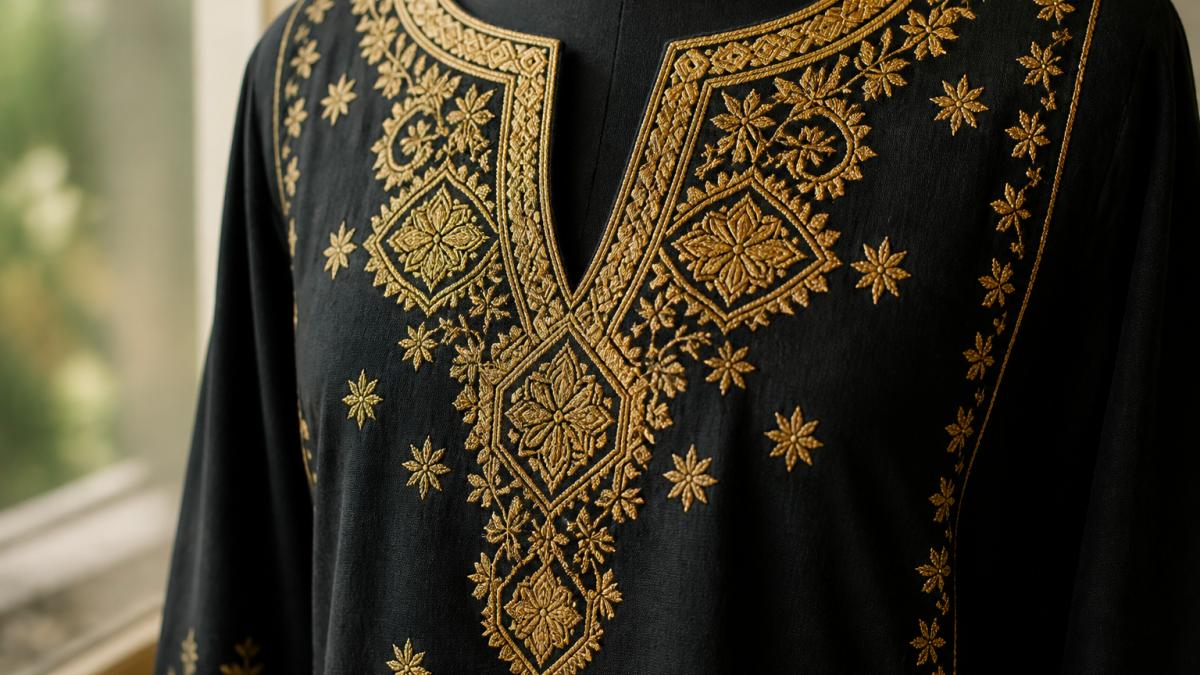
Floral, Geometric, and Tree Motifs
- Floral motifs: Stylized flowers and leaves, often arranged in a symmetrical border or a central medallion. These represent growth and celebration, which is why they appear heavily on wedding and Eid garments. A common floral layout is a central rosette with four radiating stems, mirrored left and right across the chest panel.
- Geometric patterns: Diamonds, triangles, and interlocking lines. Geometric work is the most common style on men's chest panels, and it is where you can most easily spot a machine copy, because the repetition is too perfect. The classic geometric build is a diamond grid, where each diamond is outlined first and then filled, so the grid reads as a single continuous field rather than separate shapes.
- Tree motifs: A central trunk with branching leaves, symbolizing rootedness and family lineage. Tree motifs take the longest to work by hand and are less common on mass-produced pieces, because the branching is irregular and resists a repeating machine path.
How an Authentic Khamak Pattern Is Actually Built
A hand-worked Khamak panel is constructed in a fixed sequence, and knowing that sequence is the fastest way to read a piece.
- Layout and counting. The artisan marks the centerline of the chest panel and counts threads outward to place the first motif. Symmetry is planned on the fabric grid, not drawn freehand. This is why authentic panels are balanced even when the two sides differ slightly.
- Outline first. Each motif is outlined before anything is filled. The outline is usually worked in chain or tambour stitch, moving in one continuous direction along the shape's edge.
- Fill second. The interior is filled with yurma, worked in rows that follow the shape's contour rather than crossing it at random. Fill rows sit close enough to cover the ground fabric but loose enough to keep the thread raised.
- Joining motifs. Separate motifs are connected by narrow linking lines or shared borders, so the panel reads as one composition. The joins are where hand work most often shows small gaps or overlaps.
- Density control. Dense geometric fields use tighter fill spacing; floral and tree motifs use looser fill so the shape stays legible. Density, not stitch count alone, is what gives a panel its weight and relief.
Reading Density, Direction, and Symmetry
Three things tell you how a pattern was made:
- Stitch direction: In hand work, fill rows shift direction slightly from one motif to the next as the artisan turns the fabric. Machine fill runs in one locked direction across the whole panel.
- Density: Hand fill varies, a few rows sit closer, a few sit wider, because tension changes with the hand. Machine density is uniform to the millimeter.
- Symmetry: The pattern is usually mirrored across the chest panel. Hand-worked Khamak shows tiny variations between the left and right sides. That asymmetry is not a flaw. It is the signature of a human hand.
Motif Glossary at a Glance
| Motif | Typical placement | Common meaning | Hand-work tell |
|---|---|---|---|
| Rosette / stylized flower | Central medallion, borders | Growth, celebration | Petal edges vary slightly |
| Diamond grid | Men's chest panels | Protection, order | Grid lines waver at joins |
| Interlocking line | Borders, framing bands | Continuity | Line thickness shifts |
| Tree / branching | Larger panels, heirloom pieces | Rootedness, lineage | Branches are irregular |
| Leaf pair | Flanking florals | Balance | Two leaves rarely identical |
Use this glossary as a starting vocabulary, not a fixed catalog. Regional workshops rename motifs, and the same shape can carry different meanings from one family tradition to the next.
Khamak Embroidery Stitches: Tambour, Chain, and Yurma
Khamak embroidery stitches are built around three core techniques: the tambour stitch, the chain stitch, and yurma. The tambour stitch is worked with a small hook rather than a needle, pushed through the fabric from above to form a continuous looped line. The chain stitch creates a linked, raised line that gives Khamak its characteristic texture. Yurma is a filling stitch used to build up solid shapes inside an outline.
A single chest panel may combine all three stitches. The outline is usually chain or tambour, and the interior of each motif is filled with yurma. This layering is what gives Khamak its depth and its slight relief when light hits the thread.

Handmade Khamak Embroidery vs Machine-Made: How to Tell
Handmade Khamak embroidery and machine-made work differ in three visible ways: thread tension, pattern repetition, and the back of the fabric. Machine embroidery produces identical motifs at identical angles. Hand work does not.
Here is what to compare side by side:
| Feature | Handmade Khamak | Machine-Made |
|---|---|---|
| Motif repetition | Slight variations between repeats | Identical every time |
| Thread tension | Looser, slightly raised | Tight, flat, uniform |
| Fabric back | Irregular, visible thread ends | Dense backing, often stiff |
| Cost | Higher, reflects hours of work | Lower, faster to produce |
| Care needs | Gentle hand care | Often machine washable |
Neither option is "wrong." Machine Khamakdozi gives you the same visual language at a lower price, and for everyday wear that trade-off makes sense.
An Authenticity Checklist for Buyers
- Inspect the back: irregular thread ends suggest hand work
- Compare left and right chest panels for small differences
- Feel the embroidery: hand work sits slightly raised, not flat
Caring for Embroidered Afghan Clothing: Washing and Storage
Caring for embroidered Afghan clothing comes down to protecting the thread, not just the fabric.
For hand-embroidered pieces, dry cleaning is the safest route. Our own hand Khamak garments, such as the Men's Black Parahan Tumban with Gold Hand Khamak Embroidery, are labeled dry clean only for exactly this reason.
Storage matters too. Fold embroidered garments rather than hanging them, so the weight of the fabric does not pull at the stitching. Keep them out of direct sunlight, and avoid plastic bags that trap moisture.
Regional Styles and Historical Roots of Khamak
Regional variation is the clearest proof of Khamak's history, and it is also the area where most guides stay vague. Naming the regions and the related traditions is what lets you source a piece honestly and describe it accurately.
Men’s Black Parahan Tumban with Gold Hand Khamak Embroidery – Luxury →
Kandahar Khamak and Its Neighbors
Khamak is most closely associated with Kandahar, in southern Afghanistan, where the technique was used to decorate men's and women's traditional clothing, particularly the chest panel of the parahan. From that center, the craft traveled along trade and family routes, and the terminology shifted with it.
A useful distinction for buyers and sellers:
- Kandahar Khamak: Dense geometric fields, gold and white thread on dark ground, tight fill. This is the style most people picture when they say "Khamak."
- Related regional embroidery: Neighboring embroidery traditions share the hook-and-chain technique and the mirrored chest-panel layout but favor looser floral arrangements and lighter palettes. These are cousins of Khamak, not synonyms for it.
- Khamakdozi: The general term for the craft of doing Khamak, used across regions regardless of local style. "Dozi" means sewing, so khamakdozi is literally the sewing of Khamak.
A common pattern is for a single garment to blend influences, a Kandahar-style geometric border with a looser floral center, because workshops traded patterns as readily as they traded thread.
Why Terminology Varies So Much
The craft survived through family workshops, passed from one generation of artisans to the next. Because the knowledge moved by apprenticeship rather than by manual, the same motif can carry different names in different families, and the same name can describe different motifs.
What unites the tradition is the technique: the hook, the chain, the fill, and the patience to repeat a motif hundreds of times.
Sourcing and Describing a Piece Honestly
If you are buying or reselling, describe a piece by what you can actually verify:
- Technique: hand-worked or machine-worked, based on the back and the fill.
- Style family: geometric-dominant or floral-dominant, and whether it reads as Kandahar-type density.
- Construction: outline stitch used, fill stitch used, and whether motifs are joined by linking lines.
Avoid claiming a specific village or workshop unless the seller can document it. Regional attribution is easy to assert and hard to prove, and overclaiming is the fastest way to lose a buyer's trust.
For buyers in the United States, this history is the reason authenticity matters. A hand-worked piece carries hours of an artisan's time. A machine copy carries none.
Conclusion: Why Authentic Khamak Patterns Matter
Understanding authentic khamak patterns changes how you shop. You stop buying a look and start buying a technique, and you can tell the difference in thirty seconds by turning the garment over.
If you want pieces where the Khamak work is the point, Luqmaan Boutique curates hand-embroidered and machine-embroidered Afghan traditional clothing for men, women, and children, including signature Shesha Yakhan and Khamak-inspired designs in premium cotton blends.
Frequently Asked Questions
What is Khamak embroidery?
Khamak embroidery is a traditional Afghan needlework style where artisans use a small hook to create raised, textured patterns on fabric. Unlike flat surface embroidery, Khamak builds up thread in loops that form geometric and floral motifs. It is most commonly seen on the chest panels and cuffs of Parahan Tumban garments. The technique requires precision and patience, as each stitch is placed by hand to create a three-dimensional effect that catches light and adds depth to the fabric.
How can you tell if Khamak embroidery is handmade?
Handmade Khamak embroidery has slight variations in stitch tension and thread placement that machine work cannot replicate. Look for tiny imperfections in the pattern symmetry, visible thread texture, and a raised, dimensional quality. On the reverse side, handmade work often shows a cleaner finish with fewer loose threads. Machine-made versions tend to have perfectly uniform stitches and a flatter appearance. A close inspection of the embroidery's depth and subtle irregularities is the most reliable indicator.
What stitches are used in Khamak embroidery?
Khamak embroidery primarily uses the tambour stitch, which involves a small hook to pull thread through the fabric in continuous loops. Chain stitch and yurma are also common, creating different textures and outlines. The tambour stitch gives Khamak its characteristic raised, beaded look. Artisans often combine these stitches within a single pattern to add variety and visual interest. The choice of stitch affects how light reflects off the embroidery and how durable the finished piece will be over time.
How should Khamak-embroidered clothing be cared for?
Dry cleaning is the safest option for Khamak-embroidered garments to preserve thread color and stitch integrity. If hand washing, use cold water and a gentle detergent, then lay flat to dry away from direct sunlight. Never wring or twist the fabric, as this can distort the embroidery. Store folded with acid-free tissue paper between layers to prevent snagging. For items like the Men's Black Parahan Tumban with Gold Hand Khamak Embroidery, dry clean only to maintain the gold thread's shine and the fabric's structure.
What garments commonly feature Khamak embroidery?
Khamak embroidery appears most often on traditional Afghan Parahan Tumban outfits, particularly on the chest panel, cuffs, and neckline. It is also found on waistcoats, shawls, and accessories like headwear. The embroidery is typically concentrated on areas that draw the eye, such as the front of a garment, to showcase the artisan's skill. Modern interpretations may place Khamak on contemporary silhouettes, but the traditional placement on formal and festive wear remains the most common.
How is Khamak embroidery different from other Afghan embroidery styles?
Khamak is distinguished by its raised, textured surface created with a tambour hook rather than a standard needle. Other Afghan embroidery styles may use flat stitches or different tools, resulting in a smoother finish. Khamak's dimensional quality and the use of metallic threads like gold and silver set it apart. The patterns also tend to be more geometric and densely packed than some other regional styles, giving Khamak garments a bold, luxurious appearance that stands out at formal events.
Authentic Khamak is a craft you can verify with your own eyes, and that is exactly how we would want you to shop for it. Luqmaan Boutique offers hand Khamak embroidery on premium cotton-blend Parahan Tumban sets, with clear sizing and care guidance on every listing. Explore the collection and choose a piece that carries the craft forward.