

How to Identify Authentic Khamak Embroidery
Table of Contents
- What Is Khamak Embroidery? A Definition
- Why Authenticity Matters: Textile Heritage and Cultural Preservation
- Step-by-Step: How to Identify Authentic Khamak Embroidery
- Hand-Stitched vs Machine Embroidery: Key Differences
- Hand-Stitched vs Machine Embroidery: Key Differences
- Regional Pattern Variations and Motif Identification
- Best Embroidered Parahan Tunban for Summer Weddings
- Best Embroidered Parahan Tunban for Summer Weddings
- Caring for Delicate Handmade Embroidery
- Conclusion
- Frequently Asked Questions
Last Updated: September 28, 2026
What Is Khamak Embroidery? A Definition
Khamak embroidery is a traditional counted-thread embroidery from Kandahar, worked in white cotton or silk thread to create raised, geometric patterns on fabric. Artisans count each thread of the base cloth, then build up satin-stitch blocks until the design sits slightly above the surface, producing a dense, matte panel that looks almost carved into the garment.

Why Authenticity Matters: Textile Heritage and Cultural Preservation
Buying authentic khamak keeps a specific skill alive. Each genuine piece represents hours of handwork by an artisan who trained for years. When buyers accept machine copies, artisans lose income, and the technique loses the next generation of stitchers.
- Hand-stitched khamak ages differently. The thread sits on top of the cloth, so it wears gradually instead of cracking off in sheets.
- Authentic pieces hold value. A well-kept handmade garment stays wearable for years.
- Copies fail fast. Printed or glued "embroidery" lifts, fades, and peels after a few washes.
Step-by-Step: How to Identify Authentic Khamak Embroidery
You can verify a piece in three checks: the front, the back, and the thread. Do them in that order, each targets a different failure mode, so a copy that passes one will almost always fail the next.
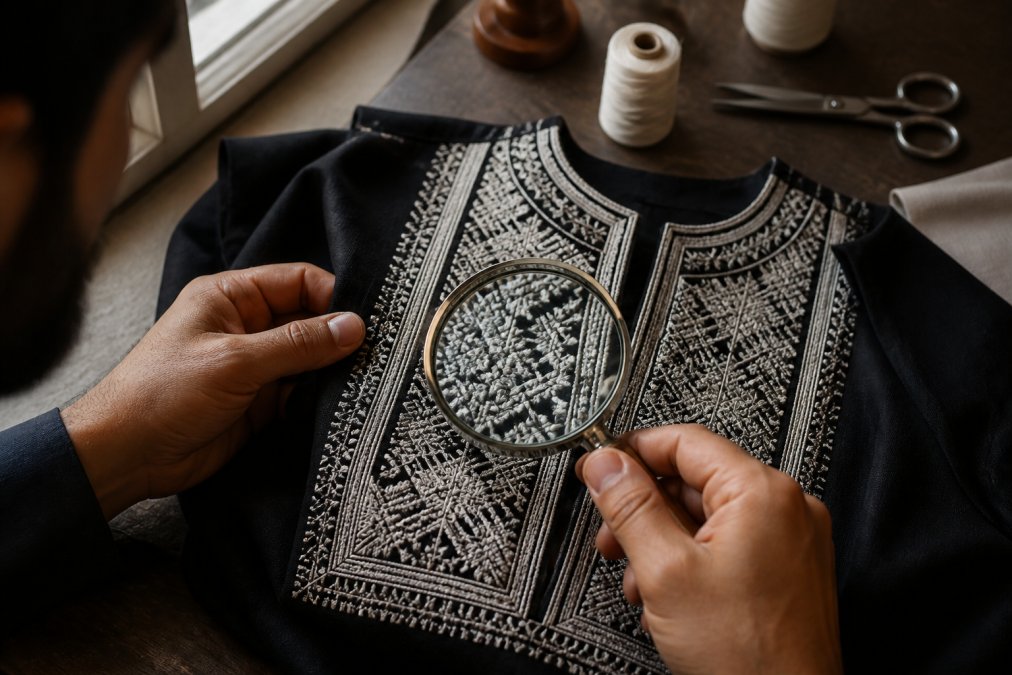
Step 1: Examine the Front Surface for Stitch Density and Geometric Precision
Start with your eyes, then your fingertips, then a magnifier. The first two catch obvious fakes; the magnifier catches good ones.
At arm's length:
- Look for density. Real khamak covers the cloth so tightly that you barely see the base fabric underneath. Gaps between stitches are a red flag.
- Check the geometry. Patterns should be symmetrical and even; counted-thread work is built on a grid, so lines stay straight and corners meet cleanly.
- Feel the surface. Authentic khamak sits slightly raised because the thread is layered. A flat, smooth surface usually means print or machine work.
- Study the edges. Hand-stitched motifs vary slightly at the borders; perfect, razor-sharp edges across a large panel often point to a machine.
Under magnification (a 10x jeweler's loupe is enough):
- Stitch tension irregularity. Each satin-stitch block is pulled by hand, so stitches sit at slightly different heights and angles, and the block's top edge undulates by a fraction of a millimeter.
- Machine uniformity. Machine embroidery produces stitches of identical length, angle, and tension, reading as a flat, repeating tile. If a 6-inch panel shows zero variation in stitch height, it was not made by hand.
- Grid alignment. Because khamak is counted-thread, the embroidery grid locks to the fabric weave. Printed imitations show ink sitting on top of the weave with no relationship to the thread intersections underneath.
- Thread coverage. In real khamak, the thread wraps over the base cloth so completely that the weave disappears beneath it. In prints, the base weave remains visible through the ink.
Step 2: Turn the Garment Over for Back-Side Inspection
The back of the embroidery is the single most reliable authenticity check. Front surfaces can be faked with print, appliqué, or machine work, but faking the back means doing the handwork.
What authentic hand-stitched khamak looks like on the back:
-
A mirrored ghost of the front pattern. Because the artisan works the design through the cloth, the reverse shows the same geometric shapes, just softer and less defined.
-
Visible thread travel between motifs. When the artisan moves from one block to the next, the working thread crosses the back of the fabric. These travel threads are the clearest proof of handwork.
-
Small knots or thread tails. Handwork leaves starting and ending knots, sometimes tucked under stitches but findable under good light.
-
Slight puckering or tension marks. Where dense stitching pulls the cloth, the back may show faint dimpling, normal in dense handwork.
-
No fused backing. Authentic khamak does not need a stiff interfacing; the stitching itself gives the panel structure.
-
Perfectly clean and blank. If the front shows a complex pattern and the back shows nothing, the pattern was printed or applied to the front only.
-
A stiff, fused backing layer. Many machine-embroidered and printed pieces use a glued or heat-fused stabilizer, felt as a stiff, papery, or plastic-like sheet bonded to the reverse.
-
Machine bobbin thread. Machine embroidery leaves a dense, uniform bobbin-thread pattern on the back, often a tangled but perfectly even mesh that looks nothing like the front design.
-
Glue residue or a smooth coated surface. If the back feels slick or coated, the front is likely a print or appliqué.
Step 3: Test Thread Composition and Matte Finish
Finally, examine the thread itself. This catches pieces that pass the front and back checks but use cheap synthetic thread.
Visual test, matte versus sheen:
- Matte, not shiny. Authentic khamak uses cotton or silk thread with a soft, matte finish. Cheap polyester thread has a plastic sheen.
- Color depth. Natural-dyed or quality thread shows subtle variation across a panel; printed designs and low-grade synthetic thread look uniformly flat or bright.
- Hold it under natural daylight. Matte thread absorbs light and reads soft; synthetic thread reflects light and reads bright or slightly metallic.
Tactile test, texture versus slickness:
-
Roll a single stitch between your fingers. Real cotton or silk has a slight grip and a dry feel; synthetic thread feels slick and cool, almost like fishing line at fine gauges.
-
Press a fingernail gently against a stitch. Cotton and silk give slightly and spring back; polyester resists and feels hard.
-
Rub the thread against your lip or inner wrist. Natural fibers feel warmer and slightly rougher; synthetics feel cooler and smoother. Do this only on a hidden area or swatch, never a visible panel.
-
Cotton: burns like paper, smells like burning paper, leaves soft gray ash.
-
Silk: burns slowly, smells like burning hair, leaves a crushable black bead.
-
Polyester/synthetic: melts and shrinks away from the flame, smells chemical, leaves a hard black bead that will not crush.
Base cloth check:
- Thread count of the base cloth. Fine cotton or silk holds dense stitching without puckering; thin, loose cloth cannot support real khamak because the stitches would pull through.
- Puckering pattern. Some puckering around dense hand embroidery is normal. Uniform, all-over stiffness usually indicates a fused backing.
Hand-Stitched vs Machine Embroidery: Key Differences
Hand-Stitched vs Machine Embroidery: Key Differences
The fastest way to tell hand-stitched from machine embroidery is consistency: machines are perfect, hands are not.
| Feature | Hand-Stitched Khamak | Machine Embroidery |
|---|---|---|
| Stitch surface | Raised, layered, textured | Flat, even, uniform |
| Pattern edges | Slight natural variation | Razor-sharp, identical repeats |
| Back side | Mirrored pattern, visible thread travel | Clean, fused, or blank |
| Thread finish | Matte cotton or silk | Often shiny synthetic |
| Feel | Dense, slightly bumpy | Smooth, sometimes stiff |
| Time per panel | Many hours of handwork | Minutes |
Regional Pattern Variations and Motif Identification
Khamak patterns follow regional and family traditions, and learning the common shapes helps you spot both a real design and a regional imitation. The classic look is geometric: diamonds, stepped squares, chevrons, and interlocking blocks. Whitework on a dark base is the most recognized combination, though gold and multi-tone threadwork appear on formal pieces.
Core motif vocabulary:
- Diamond and lozenge grids: the most common khamak structure, a single large diamond or a field of small diamonds forms the backbone of most chest panels.
- Stepped or zigzag borders: often frame the main chest panel. The steps are counted, not drawn, so each should align to the fabric grid.
- Symmetrical center motifs: designed to sit exactly on the chest line.
- Repeating small blocks: counted in rows. The repetition is regular but not mechanically identical, hand-counted rows drift by a thread or two over a long panel.
- Interlocking or tessellating shapes: complex pieces use shapes that lock together like puzzle pieces, requiring the artisan to plan the entire panel before stitching.
How Regional Traditions Differ
Khamak is not produced in one place, and different production centers favor different motif scales, thread colors, and finishing conventions. Learning the broad regional signatures helps you judge whether a piece matches the tradition it claims.
Kandahari work (the reference tradition):
- Tight, small-scale motifs. Kandahari khamak favors fine, densely packed geometric blocks rather than large open shapes.
- Whitework dominance. White thread on dark or neutral base cloth is the most characteristic Kandahari combination, especially for everyday and ceremonial parahan tunban.
- Restrained color. Color is usually limited to one or two accent tones, gold, deep red, or green, rather than a full palette.
- Symmetry as a rule. Kandahari panels are strongly symmetrical, with the center motif aligned to the wearer's chest line.
Other regional signatures to watch for:
- Larger motif scale. Some centers favor bigger diamonds and broader borders, a different design convention, not automatically a copy. Judge construction first, scale second.
- Bolder color palettes. Multi-tone pieces are more common in some regions than in Kandahar. If the palette is broad but the stitching is dense and irregular, the piece may still be authentic, just from a different tradition.
- Different border treatments. Some regions favor wide, multi-row borders; others use a single narrow frame. Border style is a regional marker, not an authenticity marker.
- Variation in base cloth. Kandahari work is often on fine cotton or silk; other regions may use heavier cotton or blends. Heavier base cloth is not a red flag if consistent with the claimed origin.
Distinguishing Authentic Regional Work from Regional Imitations
The harder problem is not 'is this khamak?' but 'is this the khamak it claims to be?' A piece can be hand-stitched and still be a regional imitation, handwork produced elsewhere and sold under a Kandahari label.
Use these checks:
- Motif-to-claim consistency. A piece sold as Kandahari should match Kandahari motif scale, color palette, and symmetry. A large-scale, multi-color, asymmetrical panel sold as 'traditional Kandahari' is inconsistent with the tradition.
- Stitch density relative to motif scale. Fine Kandahari motifs require very dense stitching. Small motifs with loose stitching mean the artisan lacked the skill or time to execute the tradition properly.
- Thread quality relative to price point. Premium Kandahari handwork should use matte cotton or silk thread; synthetic thread is a mismatch.
- Finishing details. Kandahari pieces often finish chest panel edges with a clean, narrow border. Sloppy or unfinished edges on fine work are a warning sign.
- Consistency across the panel. Hand-counted work drifts slightly but consistently. If one section is dense and another loose, the piece may be assembled from multiple sources or partially machine-finished.
Using Magnification to Read the Grid
Under magnification, counted-thread work shows a clear grid structure, the embroidery locked to the warp and weft of the base cloth. Printed imitations show ink sitting on top of the weave. Look for three things:
- Grid lock. The embroidery blocks should align to the fabric weave. If the pattern floats independently, it is printed or appliquéd.
- Counted steps. In stepped borders, each step should span a consistent number of fabric threads. Hand-counted steps may vary by one thread, but not by five.
- Thread coverage at motif edges. At each motif's edge, the thread should wrap over the base cloth. Prints show the base weave continuing through the ink.
Best Embroidered Parahan Tunban for Summer Weddings
Best Embroidered Parahan Tunban for Summer Weddings
For a summer wedding, choose a lightweight cotton-blend parahan tunban with hand khamak embroidery on the chest, in a light or neutral base color that reflects heat. Heavy, dark pieces trap heat no matter how beautiful the embroidery is; a light grey or tan base with white or gold khamak threadwork gives you the traditional look without the weight.
Luqmaan Boutique carries several pieces that fit this brief:
- Men's Grey Parahan Tumban with White Hand Khamak Embroidery (XXL) - $79.99. A premium cotton-poly blend with white hand khamak on the chest. Breathable enough for warm events and formal enough for a wedding.
- Men's Black Parahan Tumban with Gold Hand Khamak Embroidery (Medium) - $89.99. Bold gold threadwork on deep black. Best for evening weddings and indoor celebrations.
- Golden Tan Afghan Parahan Tumban with Khamak-Style V-Pattern Embroidery (Large) - $109.99. A warm tan base with coordinated V-pattern stitching across the chest and sleeves. The lightest look of the three.
Caring for Delicate Handmade Embroidery
Handmade khamak lasts for years if you treat it gently. The thread sits above the cloth, so rough washing is the main threat.

- Dry clean when possible. It is the safest option for dense handwork and color depth.
- If washing by hand: use cold water and a mild detergent. Never bleach.
- Never wring or twist. Press water out gently, then lay flat to dry.
- Dry flat, away from direct sun. Hanging wet embroidery can stretch the panel.
- Store folded, not hung. Long-term hanging strains the shoulder seams.
- Keep away from rough surfaces. Snags pull the raised thread.
- Iron on low, from the back. Never press directly on the embroidery.
Conclusion
Knowing how to identify authentic khamak embroidery comes down to three checks: dense, raised stitching on the front, a mirrored pattern on the back, and matte cotton or silk thread. Master those, and no copy will fool you.
Frequently Asked Questions
What makes khamak embroidery unique compared to other counted-thread styles?
Khamak embroidery is unique because artisans count individual threads to place every stitch, creating raised geometric patterns with a matte, textured finish. Unlike cross-stitch, which lies flat, khamak sits slightly above the fabric surface. The technique uses fine cotton or white silk thread on cotton ground fabric, and the geometric precision is achieved without printed guides or templates. This counted-thread method is what gives authentic khamak embroidery its dimensional quality and makes it difficult to replicate by machine.
How can you tell the difference between handmade and machine embroidery?
Flip the garment over. Hand-stitched khamak embroidery shows slight irregularity on the back, with visible knots and thread tails where the artisan started and stopped. Machine embroidery produces a uniform, flat reverse with tight, consistent tension and no loose ends. On the front, hand-stitched work has subtle variations in stitch angle and density, while machine work looks identical across every repeat. These hand-stitched vs machine embroidery differences are the fastest way to verify authenticity.
What materials are traditionally used in authentic khamak?
Authentic khamak embroidery uses fine cotton or white silk thread stitched onto a cotton ground fabric. The thread has a matte finish and a slightly textured hand, unlike the shiny polyester threads common in machine work. Some pieces incorporate colored silk for accent motifs, but the traditional whitework style relies on white thread against white or light fabric. If the embroidery thread feels slick or reflects light sharply, it is likely synthetic and machine-applied.
How should you care for authentic khamak embroidered garments?
Dry cleaning is recommended to preserve both the embroidery and the fabric color. If hand washing, use cold water with a mild detergent and never wring or scrub the embroidered area. Lay flat to dry away from direct sunlight. Store folded with acid-free tissue between layers to prevent thread abrasion. Avoid hanging heavy pieces on wire hangers, which can distort the shoulders and stress the embroidery.