

How to Measure for Ethnic Wear: A Complete Guide
Table of Contents
- Essential Tools for Measuring Ethnic Wear
- How to Measure for a Kameez: Bust, Waist, and Hips
- Understanding Shoulder Width and Sleeve Length
- Neck Depth and Kameez Length: Vertical Measurements
- Tips for Accurate Body Measurements Every Time
- Measuring for Custom Ethnic Outfits: Ease Allowance and Fit
- How to Use a Size Chart and Troubleshoot Fit Issues
- Frequently Asked Questions
Last Updated: September 27, 2026
Essential Tools for Measuring Ethnic Wear
Getting the right fit starts with the right tools, and knowing how to measure for ethnic wear starts with the right tools. Learning how to measure for ethnic wear begins with a soft measuring tape, the flexible kind tailors use, because a stiff tape will not follow the curve of your body. Beyond that, you need a few simple items most households already have.
Here is what to gather before you start:
- A soft measuring tape, ideally 60 inches long
- A mirror, or a friend to help with hard-to-reach spots
- A fitted top and leggings, not loose clothing
- A pen and paper, or your phone's notes app
- A thin belt or ribbon to mark your waistline
The belt trick is one most people miss. Tie it around your middle and let it settle where your body bends. That is your true waistline, not where your jeans usually sit.
How to Measure for a Kameez: Bust, Waist, and Hips
A kameez is a long tunic worn over loose trousers and the centerpiece of most South Asian and Afghan wardrobes. For it to drape well, three measurements matter most: bust, waist, and hips. Get these right and the rest of the fit usually falls into place.
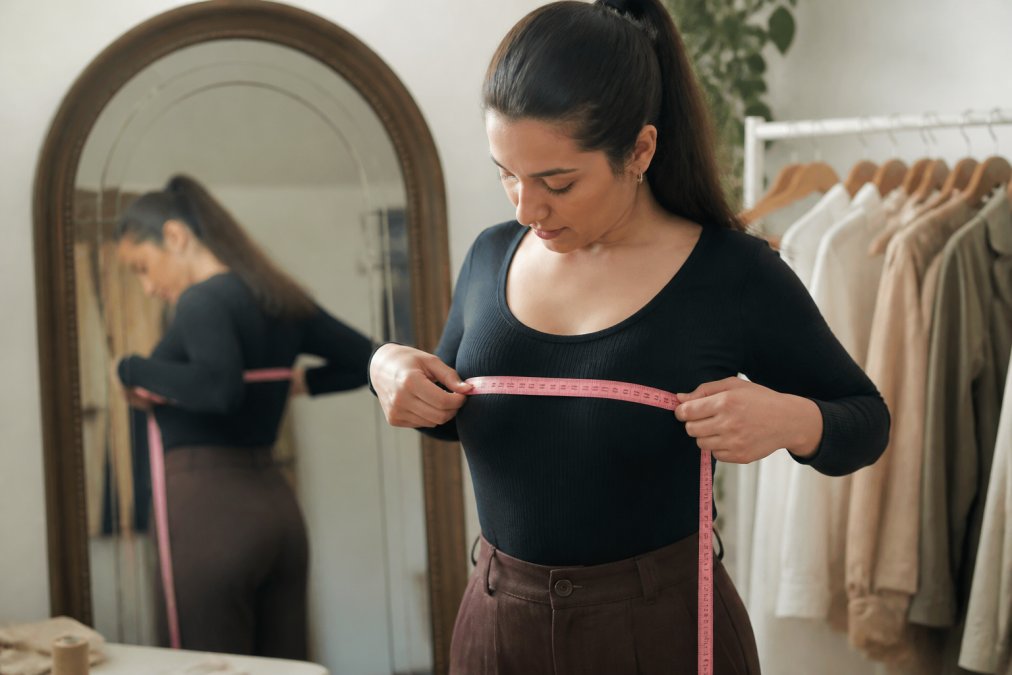
But here is what most guides leave out: the same body numbers produce a different fit depending on the silhouette. A straight-cut kameez and an Anarkali cut from the same bust measurement will not hang the same way, because each style carries a different amount of ease.
Measuring Bust Circumference
Bust circumference is the full distance around the fullest part of your chest, measured horizontally. Keep the tape level and parallel to the floor, and do not pull it tight or let it sag at the back.
Finding Your Natural Waistline
Your natural waistline is the narrowest part of your torso, usually just above your belly button. Bend sideways and the crease marks the spot. Measure there with the tape snug but not squeezing.
Hip Measurement for Ethnic Wear
Hip measurement is the distance around the fullest part of your hips and seat, usually about 8 inches below your waist. This number decides how a kameez or full-length outfit falls: too tight and the fabric pulls, too loose and the ethnic silhouette loses its shape.
Matching the Measurement to the Silhouette
Once you have your three numbers, the cut tells you what to do with them:
- Straight-cut kameez: send bust, waist, and hip, and let the tailor apply 2 to 3 inches of ease at the chest and 2 to 4 at the hip.
- Anarkali: send bust and shoulder as the primary numbers, plus waist for the fitted bodice section. The flare handles the hip.
- A-line kameez: send bust and hip. The cut widens gradually from the shoulder, so the waist is less critical.
- Angrakha or wrap styles: send bust and waist, since the overlap panel crosses the torso and a loose waist number will make the wrap sit wrong.
Understanding Shoulder Width and Sleeve Length
Shoulder width decides whether a kameez sits correctly, and it is the measurement people get wrong most often. Measure from the edge of one shoulder to the other, straight across your back, not around the front.
| Size | Chest Width | Shoulder Width | Body Length | Sleeve Length |
|---|---|---|---|---|
| Small | 22.5" | 18" | 42" | 23" |
| Medium | 23" | 18.5" | 43" | 23" |
| Large | 25.5" | 19" | 44" | 23.5" |
Neck Depth and Kameez Length: Vertical Measurements
Neck depth and kameez length are the two vertical numbers that separate a tailored garment from a borrowed-looking one. Both are measured downward, and both are easy to get wrong.
Tips for Accurate Body Measurements Every Time
Accurate body measurements come down to consistency, not skill. Measure the same way each time and your numbers will hold up across every order.
A few habits that make a real difference:
- Measure in the morning, before meals, for the steadiest numbers
- Keep the tape level and parallel to the floor on every horizontal measurement
- Snug, not tight. You should be able to slip one finger under the tape
- Write down every number, even the ones you think you will remember
- Re-measure every six months, since bodies change quietly
Measuring for Custom Ethnic Outfits: Ease Allowance and Fit
Ease allowance is the extra room added to your body measurements so a garment can move with you, and it is the biggest gap in most measurement guides. Your body fit is the raw number; ease turns that number into clothing you can actually wear.
How much ease depends on the garment:
- Fitted kameez: add 2 to 3 inches at the chest
- Relaxed or loose kameez: add 4 to 6 inches
- Tunban or loose trousers: add 2 to 4 inches at the hip
- Children's wear: add extra, since kids grow fast
How to Use a Size Chart and Troubleshoot Fit Issues
A size chart only works if you compare it to garment measurements, not your body, the part almost everyone skips. Chart numbers describe the finished garment, flat and unstretched, so they are always larger than your body numbers. That gap is the ease built in.
To use a chart correctly:
- Take your body measurements first, over fitted clothing
- Find the size whose garment numbers sit comfortably above your own
- Check the shoulder width and body length, not just the chest
- Compare against a garment you already own and love, laid flat and measured the same way
When You Fall Between Two Sizes
This is the most common fit problem in online ethnic wear, and the answer depends on the silhouette, not a blanket rule.
- Straight-cut kameez or kurta: size up. A straight cut has little give through the chest and shoulder, and a tailor can take in a side seam in minutes.
- Anarkali or flared styles: size to your bust and shoulder, not your hip. The flare below the waist is cut generously, so a larger hip number rarely matters.
- Tunban or loose trousers: size to your hip and choose the drawstring or elastic option when available, since the waist adjusts.
- Fitted choli or blouse: size to the bust and get the back altered. A blouse can be taken in at the side seams but rarely let out.
Diagnosing a Bad Fit
| Symptom | Likely Cause |
|---|---|
| Pulls across the chest | Chest number too small, or measured over bulky clothing |
| Slides off the shoulders | Shoulder width measured across the chest instead of the back |
| Hangs past the knee | Body length measured from the wrong start point |
| Sleeves stop short | Sleeve length measured to the elbow instead of the wrist |
| Baggy through the torso | Sent measurements that already included ease |
| Tight at the hip | Hip measured at the waistband instead of the fullest point |
Shoppers ordering traditional wear online for the first time, or anyone who has received a poorly fitting garment and wants to avoid a repeat.
For men's sets, our Parahan Tunban collection lists full measurements for every size, so you can match your numbers to the garment before you buy. Our Shesha embroidered sets follow the same approach, with chest, shoulder, length, and sleeve figures published for each size.


Frequently Asked Questions
What measurements do I need for ethnic wear like a kameez?
For a kameez, you need bust circumference, natural waistline, hip measurement, shoulder width, kameez length, sleeve length, and neck depth (front and back). These measurements ensure the garment fits well across the chest, waist, and hips, and that the length and sleeves are right. Always use a soft measuring tape and keep it snug but not tight. For custom outfits, also measure armhole and bottom hem.
Should I measure over my clothes or against my skin for ethnic garments?
Measure against your skin or over lightweight, fitted clothing like a thin t-shirt or leggings. Bulky clothing adds extra inches and leads to an inaccurate fit. For women, wearing a well-fitting bra is essential for accurate bust measurement. If you must measure over clothes, subtract about 1-2 inches to account for fabric thickness. Consistency matters: always measure the same way each time.
How do I ensure my measurements are accurate when ordering ethnic wear online?
Use a soft measuring tape, stand straight, and keep the tape parallel to the floor. Measure twice to confirm. Compare your measurements to the brand's size chart, noting that ethnic wear often has a looser fit than Western clothing. If you're between sizes, size up for a relaxed look or down for a fitted silhouette.
What is the difference between body measurements and garment measurements?
Body measurements are taken directly on your body, while garment measurements are taken on a flat-laid garment. When shopping online, size charts usually list body measurements, but some brands provide garment measurements. Always check which type is used. If only garment measurements are given, compare them to a similar garment you own that fits well. This helps avoid surprises.
Sizing is where most online ethnic wear orders go wrong, and it rarely has anything to do with the garment. It comes down to numbers taken once, written down, and checked against the chart. Luqmaan Boutique publishes exact measurements on every piece, from our handcrafted Shesha Yakhan designs to our Khamak-inspired embroidery, so you can match your body to the garment with confidence. Shop our collection and find traditional wear cut to fit you, not a guess.