

How to Verify Handmade Embroidery Quality
Table of Contents
- Why Verifying Handmade Embroidery Quality Matters
- Visual Inspection: Design Accuracy and Stitch Placement
- Hand Embroidery Quality Checklist: What to Look For
- How to Identify Hand Embroidery vs. Machine Work
- Handmade vs Machine Embroidery: Key Differences
- Durability and Care Testing
- Questions to Ask When Buying Embroidered Clothing
- Evaluating Embroidery Online: Close-Up Photo Guidance
- Frequently Asked Questions
Last Updated: October 7, 2026
Why Verifying Handmade Embroidery Quality Matters
At Luqmaan Boutique, we know that investing in handmade embroidery means buying craftsmanship, heritage, and authenticity.
Handmade pieces vary naturally, but there's a crucial difference between intentional artisan variation and poor craftsmanship or machine work disguised as handmade.
This guide walks you through inspecting embroidery like a professional: what to look for, what to ask, and how to spot red flags before you buy.
Visual Inspection: Design Accuracy and Stitch Placement
Before touching the fabric, examine the overall design. Does it match the product description? Are the patterns symmetrical where they should be?
Check Pattern Symmetry and Alignment
Pattern symmetry reveals whether the embroiderer planned carefully. Handmade work shows intentional alignment, even if not pixel-perfect. Check the center line, matching left/right motifs, border patterns, and collar details. Minor stitch variations are normal; one side noticeably different in size, spacing, or density is not. Machine work, by contrast, is perfectly uniform, if a design looks too flawless, it's likely machine-made.
Examine Thread Color Matching
Thread color consistency tells you whether the artisan planned the palette. Gold threads should be the same shade (or intentionally varied), whites and ivories should match throughout, and accent colors should stay in the same tone. Faded or inconsistent color in one section suggests poor storage, low-quality thread, or rushed work. Check the underside too, consistent color there shows the artisan didn't cut corners.
Hand Embroidery Quality Checklist: What to Look For
Use this checklist before committing to any purchase.
Stitch Density and Consistency
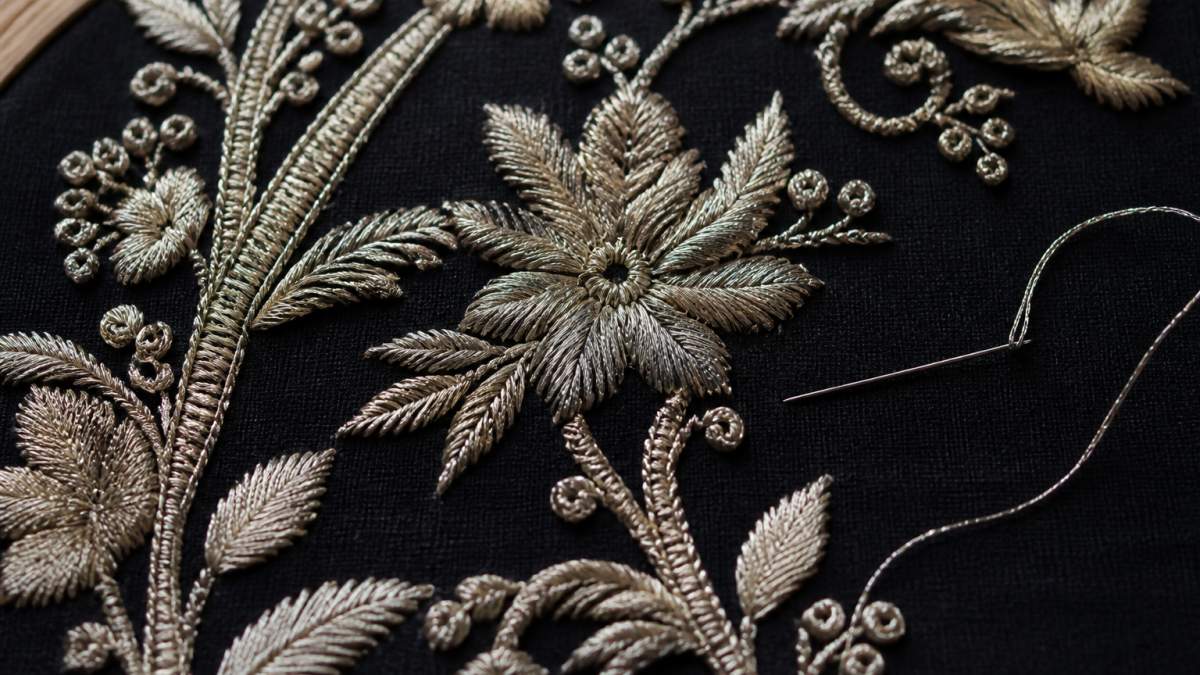
Stitch density is how tightly stitches are packed together. Dense stitching looks solid and raised; sparse stitching looks thin and weak. Quality handmade embroidery maintains consistent density, if one section is tight and another loose, the artisan rushed or lacked skill. Run your finger across the area: quality pieces feel smooth and solid, with multiple stitches packed closely in each inch, giving that characteristic raised, dimensional look.
Thread Tension and Finish Quality
Thread tension determines whether stitches lie flat or bunch up. On the top surface, stitches should sit flat with no loops, tails, or puckering, and thread should be taut without distorting the fabric. Flip the piece over: the back should show organized stitching patterns, not a tangled mess, with thread tails trimmed and secured.
Reverse Side and Backing Assessment
The back reveals whether the artisan cared about quality. Thread should be secured at the start and end of each color, stitches should follow a logical pattern, backing should be intact, and there should be no bulky knots that catch on skin or clothing. Run your hand across it, rough spots, loose threads, or sharp edges mean poor finishing. Quality handmade embroidery shows care on both sides.
How to Identify Hand Embroidery vs. Machine Work
Machine embroidery and hand embroidery look different once you know what to look for, and handmade pieces command higher prices because they require skill, time, and artistry.
Machine embroidery shows perfect uniformity: every stitch in the same spot, crisp color transitions, perfectly straight lines, razor-sharp edges, and identical tension throughout.
Hand embroidery shows intentional variation: stitches vary slightly in size and angle, color transitions may be slightly uneven, edges are softer, and tension varies subtly from stitch to stitch.
Handmade vs Machine Embroidery: Key Differences
These differences help you verify what you're buying and whether the price matches the work.
| Aspect | Hand Embroidery | Machine Embroidery |
|---|---|---|
| Stitch uniformity | Intentional variation | Perfect uniformity |
| Stitch density | Varies by artisan | Consistent throughout |
| Thread tension | Subtle variations | Identical throughout |
| Design edges | Soft, slightly uneven | Sharp, precise |
| Back appearance | Organized but varied | Structured pattern |
| Stitch placement | Natural slight offsets | Pixel-perfect placement |
| Thread color | May show slight variation | Uniform color |
| Production time | Hours per piece | Minutes per piece |
| Price point | Higher | Lower |
Machine embroidery isn't inferior, it's faster, more affordable, and right for certain applications. But if you're paying handmade prices, you should receive handmade quality.
Durability and Care Testing
Appearance checks tell you how a piece looks today; durability testing tells you how it will look after a year of wear. Use these tests before you buy, and repeat them on pieces you already own to catch problems early.
The Five-Point Durability Test
Run these checks in order. Each one isolates a different failure mode.
**1.
2. Abrasion resistance (the rub test). Rub your thumb firmly across a dense area ten times.
**3.
4. Backing integrity (the flex test). Fold the panel gently along a stitch line, then unfold.
Handmade Afghan Selmadozi Embroidered Men’s Perahan Tunban – Luxury Traditional →
5. Edge security (the perimeter check). Run your fingertip along the outer boundary of the design.
Care Protocol: What Quality Sellers Should Tell You
A durable piece still fails if cleaned wrong. Quality handmade embroidery should come with written care guidance covering four things:
- Cleaning method. Most metallic-thread hand embroidery (Selmadozi, for example) should be dry cleaned or spot cleaned only. Hand washing suits cotton and silk thread on stable fabric, but only in cool water with pH-neutral detergent, never bleach or enzyme cleaners, which digest silk and wool.
- Water temperature. Cool or lukewarm, never hot, heat sets stains and can shrink or distort the base fabric.
- Drying method. Lay flat and air dry; never tumble dry, which abrades metallic thread and can crack a stiffened backing.
- Storage. Fold along seams, not across embroidered panels, away from direct sunlight. Acid-free tissue between folds prevents transfer of oils and dyes.
Thread Type and Longevity
Thread choice predicts lifespan more than any other factor:
- Real metallic thread (foil wrapped around a silk or polyester core) resists tarnish for decades when stored dry; cheap plastic-core metallic tarnishes, flakes, and snaps within a few years.
- Mulberry silk holds color and sheen for generations but is sensitive to sunlight and alkaline detergents.
- Long-staple cotton (Egyptian or Pima) is the most washable and forgiving for everyday garments.
- Wool and wool-blend threads are warm and matte but vulnerable to moths and enzyme detergents.
Ask the seller which thread was used and whether it is colorfast. A seller who can't answer is reselling or using whatever was cheapest.
Questions to Ask When Buying Embroidered Clothing
Ask about the embroidery technique. Selmadozi (metallic thread work)? Khamak (geometric hand embroidery)?

Ask about production time. Handmade embroidery takes hours.
Ask about care instructions. Quality sellers know their pieces need special handling and provide clear guidance.
Ask about the artisan. Quality sellers know who made their work and can share that story.
Ask about authenticity. For Afghan-inspired traditional pieces, ask what makes them authentic.
Evaluating Embroidery Online: Close-Up Photo Guidance
When you can't hold the piece, photos are your only evidence. Request specific angles under specific lighting, then read the images against a short checklist, this step prevents the most disappointing purchases.
The Six Photos to Request
Ask the seller for these six images. A quality seller will provide them without hesitation because good work photographs well.
- Straight-on macro of a dense area. Close enough that individual stitches and the fabric weave are visible, reveals density, tension, and whether thread sits flat or bunches.
- Raking-light shot (light at a low 15-30 degree angle). Long shadows show raised, dimensional embroidery; flat or machine-flattened work looks smooth. This is the single most diagnostic photo you can request.
- Edge-of-design shot. Hand work shows slightly irregular stitch ends and a soft transition; machine work shows a razor-straight edge.
- Reverse-side shot. Look for organized thread runs and trimmed tails, not a tangle of knots.
- Full-piece shot on a neutral background. Verifies symmetry, placement, and that the design matches the listing.
- Scale reference shot. A coin, ruler, or hand next to the embroidery, without it, you can't judge stitch size or density.
Reading the Photos: What Each Detail Tells You
Once you have the images, inspect them in this order.
Stitch legibility. Zoom in on the macro shot, can you count individual stitches? If not, ask for a higher-resolution file or tighter crop.
Thread sheen and texture. Metallic thread should show a continuous reflective surface, silk a soft directional sheen, cotton a matte fibrous surface.
Judging Photos the Seller Did Not Take
Many listings use manufacturer or wholesale photos, not the actual item. Watch for these tells:
- The same photo appears across multiple listings or sellers.
- Background, lighting, or model changes between photos in one listing.
- Heavy filtering, oversaturated colors, smoothed texture, or blurred backgrounds hiding stitch detail.
- No scale reference in any shot.
If you suspect stock photos, ask for a live photo or short video of the specific piece with a handwritten note or the current date in frame. A legitimate seller will comply; a reseller often cannot.
Reading Reviews for Photo Evidence
Customer reviews are most useful when they include buyer-taken photos, especially images showing the piece after weeks or months of wear. Search for keywords like "loose," "frayed," "tarnished," "pulled," and "washed" to surface durability complaints. A pattern of the same complaint across reviews is a stronger signal than any single negative review.
Frequently Asked Questions
How can you tell if embroidery is handmade?
Handmade embroidery shows slight irregularities in stitch length and spacing, this is normal and expected. Check the reverse side: hand embroidery typically has visible knots, thread anchors, and uneven coverage on the back. Machine embroidery, by contrast, has perfectly uniform stitches and a clean, consistent reverse. Look for thread tails and loose ends on the back; handmade pieces often have these, while machine work is trimmed cleanly. Metallic threads like Selmadozi often appear raised and dimensional in hand embroidery, catching light unevenly.
What should you look for when checking embroidery quality?
Start with design accuracy: verify the pattern matches the product photos and is symmetrical. Examine stitch density (tightly packed stitches indicate quality), thread color matching (threads should match the intended palette without obvious mismatches), and stitch consistency (uniform tension throughout). Check for broken, skipped, or missing stitches, these are defects. Inspect the reverse side for clean anchoring and appropriate backing. Pull gently on the fabric near embroidery to test thread durability; quality work should not unravel. Finally, assess the overall finish: edges should be clean, and loose threads should be minimal.
What questions should you ask before buying embroidered clothing?
Ask the seller: Is this hand embroidered or machine embroidered? What thread materials are used (metallic, silk, cotton)? How is the garment cared for (dry clean only, hand wash)? What is the return policy if quality doesn't match the photos? Can they provide close-up images of the embroidery and reverse side? How long will delivery take? Do they offer a quality guarantee? Ask about fabric compatibility with the embroidery technique, premium pieces use stabilizers and backings appropriate to the stitch type. For formal pieces like Khamak or Selmadozi work, ask about durability testing or care instructions specific to metallic threads.
Should handmade embroidery have small irregularities?
Yes, minor irregularities are a hallmark of authentic handmade embroidery. Slight variations in stitch length, spacing, and tension are normal and actually indicate genuine hand stitching. However, irregularities should be subtle and consistent across the piece, not random gaps, obviously skipped areas, or severe tension shifts. The difference is intent: skilled artisans maintain overall design integrity while allowing natural human variation. Defects like broken stitches, missing thread sections, or loose backing are different from acceptable variation. When evaluating online, ask the seller if visible irregularities are intentional handmade characteristics or manufacturing flaws.